



Funnel EMEA: What SDR Leaders Are Really Talking About
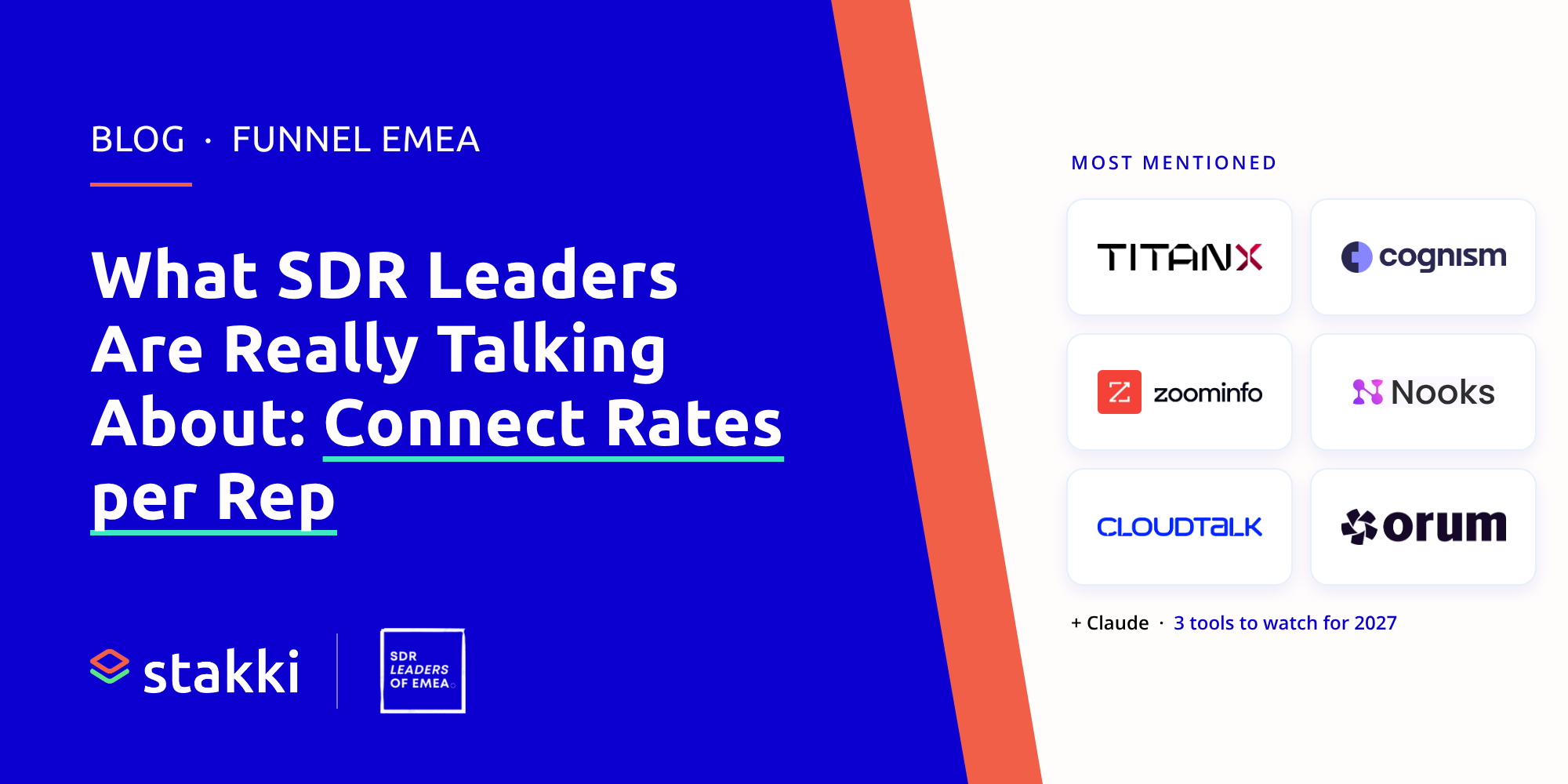
Last week the Stakki team spent the day at Funnel EMEA, and the room was full of SDR leaders who know their craft. Nobody was there for buzzwords. They talked about what they are building, what is breaking and what they are being asked to prove.
The tools came up again and again. But listen past the logos and one theme ran through almost every conversation: connect rates per rep. That metric tells you a lot about where sales development is heading, and about where SDR leaders can win real influence over the next 12 months.
The tools everyone was talking about
These names came up most often, both on stage and in the hallways:
Claude is now part of the everyday SDR workflow. Leaders use it for account research, call prep, messaging and, more and more, for analysing their own team's performance.
TitanX came up in nearly every conversation about phone. It tells reps which numbers are worth dialling before they pick up the phone.
Cognism and ZoomInfo are still holding on as the data foundation in many stacks. They are rarely loved, but they are hard to rip out.
Nooks, CloudTalk and Orum set the dialling agenda. Parallel and power dialling are now the norm for teams that take the phone seriously.
Look at that list again. Most of it is about one thing: getting reps into more live conversations, with less wasted effort per conversation.
Connect rates per rep: the metric behind the stack
Connect rate per rep has moved from an ops detail to a leadership metric. The reason is simple: do more with less.
Headcount is flat or shrinking, targets are not, and every leader in the room felt that squeeze. When you can't add reps, you have to make each rep's hours count. Better data, smarter dialling and AI-assisted prep all push one number: how many real conversations a single rep has each day.
That is a sensible response. But it is still a response. The leaders who will stand out in 2027 are the ones who get ahead of that pressure, not the ones who just buy their way through it.
The opportunity: earn your seat at the senior table
There are more tools on offer than ever. There are more opinions on what good looks like, more pressure to use AI, and more questions about how sales development should be run at all. That sounds like a threat. For the right SDR leader, it is a big opportunity.
The leader who can plan strategically becomes a real force at the senior table. The aim is simple: pipeline should never surprise leadership or the board. That takes a proper business case, built ahead of time, that accounts for:
Attrition. SDR tenure is short. Plan for ramp time, backfills and the dip in output that comes with every leaver.
Unit economics. Know your cost per meeting, cost per opportunity and cost per connect, and how each new tool changes them.
Performance across the team. Averages hide a lot. Know where output really comes from and where it is slipping.
The way to win influence is to measure the things the board can't see. The board sees pipeline. It does not see the hours lost to bad data, the rep who burned out in month four, or the reasons connect rates dropped in Q3. If you bring that view into the room, you stop reporting numbers and start shaping decisions.
Stay out of the shadows
Every SDR team knows the grey areas that eat time and never show up on a dashboard. Systems that don't talk to each other. Tools that do overlapping jobs. Weeks spent arguing with RevOps over which platform to buy.
The best leaders deal with these weeks or months before they happen. Three habits make the difference:
Plan ahead. Map out your stack, data flows and headcount against next year's targets before the budget round, not during it.
Put guard rails around AI. Decide where AI helps, such as research, prep and analysis, and where a human has to stay in the loop. Write it down.
Own how AI is used. If the SDR leader doesn't own it, someone else will decide for you, and it may not suit your team.
Keep the goal in view. Your team needs conversations with prospects, at scale, not more logins. Every tool decision should pass that test.
Three tools that impressed the Stakki team
Beyond the familiar names, three newer tools stood out. Keep an eye on them:
Frontier: the Chrome extension you'll actually want. Most extensions end up as clutter in the toolbar. This one earns its place.
Homie: strategic network and prospect mapping. It gets RevOps excited, and it could finally help enterprise reps build lists that reflect how their accounts really work.
Motileo: gamification for sales teams. It suits teams that thrive on energy, competition and clear insight into performance. This is our big bet for the tool SDR teams will love in 2027.
The takeaway
The tools will keep changing. What sets an SDR leader apart is the ability to plan ahead, build a business case the board trusts and keep the team focused on real conversations.
Thanks to SDR Leaders of EMEA and everyone who shared so openly at Funnel EMEA. If you'd like a second opinion on your stack, your business case or your 2027 plan, the Stakki team is always happy to talk.
About Stakki
Stakki is a RevOps consultancy that helps B2B revenue teams choose and implement the right sales tech. Every tool recommended has been tested first-hand by the Stakki team — 80+ sales tools implemented and integrated into more than 20 outbound teams. Clients like Clarify have cut stack costs by 61%, while RocketPhone grew pipeline from £200k to £3m in nine months.